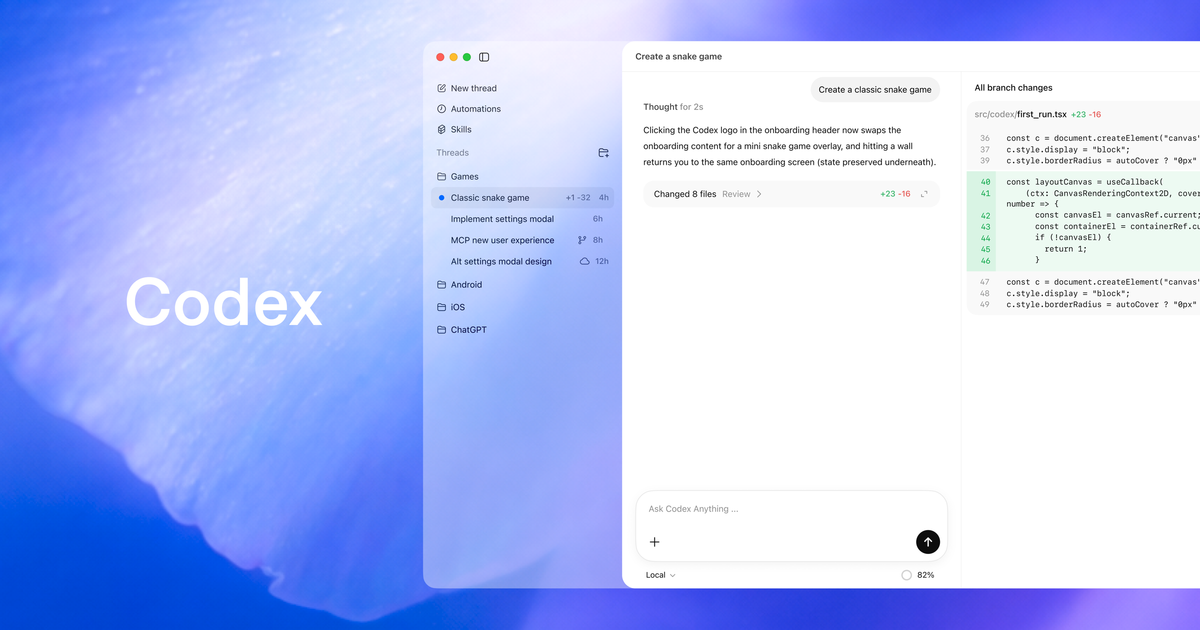
Image from OpenAI’s Codex developer documentation.
This post was inspired by a conversation I had with Elyse W. from Major League Hacking. This is how I am using Codex in my workflow at NVIDIA right now.
Report Generator Based On Templates
I do a lot of work that eventually needs to become some kind of structured update: monthly reports, trip reports, partner summaries, executive notes, or quick readouts after a campaign.
Once I have a template that works, Codex helps me reuse it:
- Pull notes into the right sections
- Keep the tone appropriate for the audience
- Flag missing numbers or unsupported claims
- Give me a draft I can edit instead of starting from scratch
My current workflow is to save reports as both Markdown and HTML files.
The Markdown version is the editable source of truth. The HTML version goes directly into an Outlook draft. My templates also know which distribution lists the reports go to, so Codex can cue up the body, audience, and expected format.
I still edit and double check. I often need to add my own insight, especially when the model misses the key point in the data. But it gets the report staged.
I also treat each report as a chance to improve the template. If I see a recurring failure, I fix it in the current report and update the template while the mistake is fresh. It not only saves me time to do my reporting this way, it improves my report quality so I miss less.
T5T Automation
T5Ts, or “Top 5 Things,” are a unique part of NVIDIA culture. They are brief weekly emails that set out an individual’s top priorities, shared with their core team, related project teams, and sometimes broader groups when useful.
They are meant to be high level: key priorities, urgent or time-sensitive work, opportunities, concerns, changes in direction, and early signals of future success or failure. They are not meant to be exhaustive todo lists or deep-dive reports.
Collectively, T5Ts help matrixed teams stay alert and aligned across projects, technologies, and geographies. Each team has its own style, cadence, and audience, but the shared habit makes it easier to quickly understand what people are focused on and where issues may be emerging.
I turned my T5T process into an automation. I took style guidance directly from our internal documentation and converted it into a repeatable workflow, so my T5T stays updated in the expected format.
This pulls from the same working context as the rest of my system: reports, notes, follow-ups, partner updates, and open threads. I still review it, but the automation keeps the draft from starting cold every time.
It also helps me self-reflect on what I think my top priorities are versus what I am actually working on. Creating a draft from all that context is a useful way to test that for myself.
Bragboard, Outcome Tracker, Accomplishment Tracker, Personal Dossier
I use Codex to take away the chore of finding small wins and keeping track of them across Slack, email, docs, and meeting notes.
This includes partner movement, program metrics, launches, event planning, follow-ups, and examples I may want later for reviews or planning conversations.
I also include my external blog and external blog analytics data. That lets Codex pull in the posts and topics people are responding to in my personal brand work, not just what is happening inside my NVIDIA workflow.
Codex Automations For My Content Roadmap
I use Codex Automations for my partner content roadmap. It looks across the places where signals show up: emails, Slack threads, partner discussions, and meeting notes.
If there is an event coming up, a partner activation in motion, livestream, hackathon, a campaign idea, or a content commitment mentioned in one of those places, it can get added to the roadmap automatically.
I keep two versions. One has the full context: source, people involved, links, rough timing, and open questions. The other is a simpler human-readable version that is easier to scan, grep, and use in the normal rhythm of work.
Work Brain Aggregator
Like many others, I run an Obsidian vault as a kind of work brain.
This is where I keep project notes, partner details, open questions, reporting snippets, recurring metrics, decisions, follow-ups, and context I do not want to reconstruct later.
Codex helps keep it populated. I can point it at rough notes, transcripts, docs, or prior drafts and ask it to pull out the parts worth saving:
- Decisions
- Open threads
- Follow-ups
- Useful links
- People and org context
- Metrics and dates
- Language that might be useful again later
Everything in the work brain also gets uploaded to our internal GitLab at regular intervals. That gives me a backup and lets me access the work brain from anywhere if I need it.
What Makes This Work
Codex works best for me when I give it:
- A place to save durable output
- Permission to ask what is missing
- A narrow job with a useful end artifact
- a systems thinking layer with templates - where prompts improve not just the artifact but also the system itself.
Hope these notes were helpful to somebody else out there! Reach out and let me know where I’m going wrong, whats helpful for you or if you have found success doing something differently.